Case study · FMCG leadership
Twelve weeks, six faces, +32.2%: how FMCG leaders at Imana Foods and Kerry Foods grew with Super-Cube®
Leaders at Imana Foods and Kerry Foods completed a 12-week, accredited Super-Cube® leadership development intervention. Across the six faces, average assessment scores rose by 32.2 percentage points from the start of the course to the end.
4 min read
The challenge
In fast-moving consumer goods, leadership happens on every shift as well as in the boardroom. Supervisors, team leaders and managers make constant calls about people, quality, safety and cost, often under pressure. Most leadership training still covers a narrow set of management skills, and very little of it measures whether anything actually changed.
Super-Cube® takes a different view. Leadership is a whole-person capability, and it can be developed and measured. The question was whether a short, structured, accredited programme could move all six faces of a leader at once, and show it in the numbers.
The intervention
Over 12 weeks, learners worked through six Super-Cube® modules, one for each face of the model, each with its own workbook. Every module set out the skills to be developed and specific, assessable outcomes. Each was SETA-accredited at NQF levels 3 to 5. Learners were assessed on three skills per face before the course and again after it.
- Choices (decision-making intelligence): Problem solving, decision making, change management, risk assessment (NQF L3 · 6 credits)
- Principles (decision-making foundations): Ethics, values and morals, organisational culture, codes of conduct, ethical governance (NQF L5 · 5 credits)
- Mental intelligence: Cognitive and self-awareness skills, study and learning skills, creativity (NQF L5 · 5 credits)
- Emotional intelligence: Social, negotiation, motivation and communication skills (NQF L5 · 4 credits)
- Physical intelligence: Wellness, stress management, discipline and alignment (NQF L4 · 8 credits)
- Spiritual intelligence: Personal, team and organisational leadership (NQF L5 · 8 credits)
The results
Every face improved. Overall leadership development, the average across all six faces, rose by +32.2%.
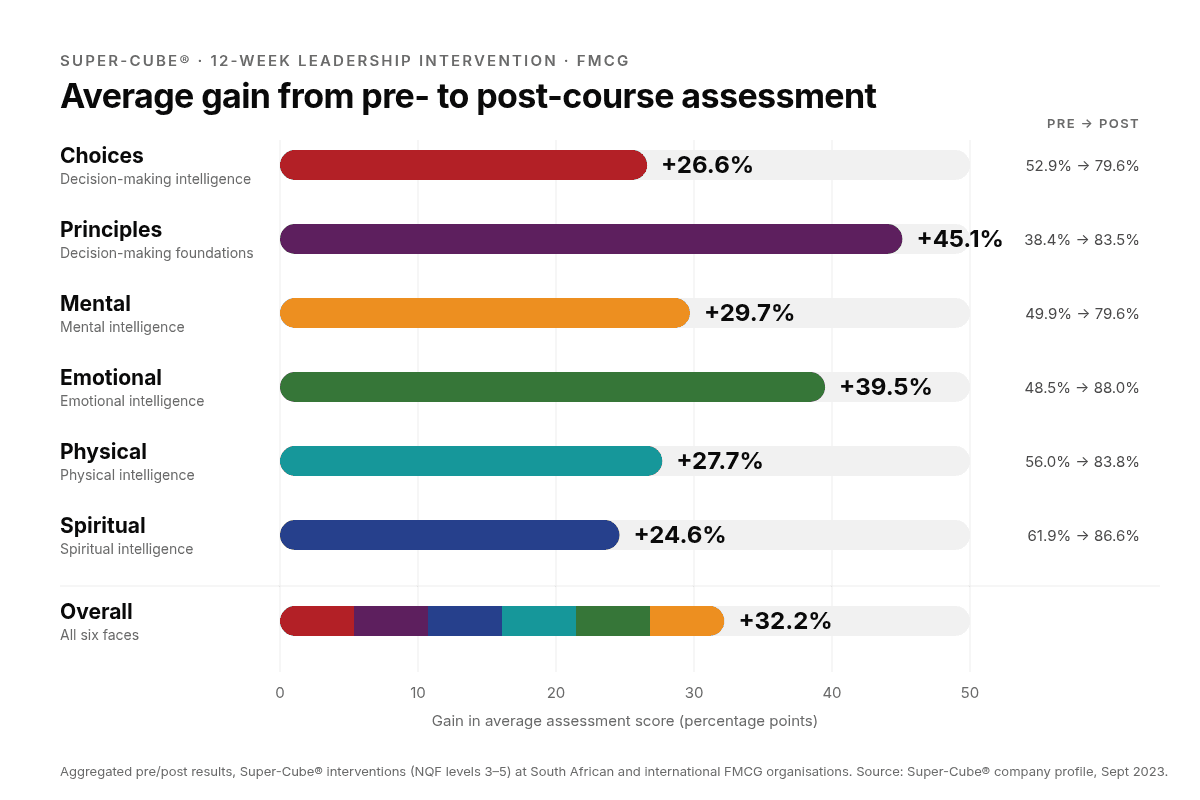
- Choices: 52.9% → 79.6% (+26.6%)
- Principles: 38.4% → 83.5% (+45.1%)
- Mental: 49.9% → 79.6% (+29.7%)
- Emotional: 48.5% → 88.0% (+39.5%)
- Physical: 56.0% → 83.8% (+27.7%)
- Spiritual: 61.9% → 86.6% (+24.6%)
- Overall, all six faces: +32.2%
Gains are the change in average assessment score, in percentage points.
Principles showed the largest gain (+45.1%). It also had the lowest starting point. Corporate governance scores climbed from 23.5% to 79.8% (+56.3%) and ethical decisions from 38.7% to 85.7% (+47.1%).
Emotional intelligence followed at +39.5%, with the highest finishing score of any face (88.0%). Conflict resolution rose from 37.0% to 83.2% (+46.2%), and understanding of emotional intelligence components doubled, from 45.4% to 90.8%.
Choices rose +26.6%. Ethical decisions moved from 46.2% to 84.9% and risk assessment from 38.7% to 73.1%. Mental gained +29.7%, led by study and learning techniques (+37.0%). Physical gained +27.7%, led by physical wellbeing (+37.8%). Spiritual gained +24.6% from the highest starting point of the six faces, with personal leadership up from 55.5% to 84.0%.
What changed for people
The numbers show the scale of the shift. The learners describe what it felt like.
"It was a wonderful and enlightening experience. I have learnt about myself weakness and strengths, and how to grow and improve as a person. I feel the content learnt will help me be a great manager and leader in the future."
— Kaveshin Govender, Kerry Foods
"This programme has been a journey of learning, growth and development. The model has potential to engage and influence people across age, education, class and culture as it is not bound to a rigid concept or theory of what a leader or leadership is. Instead, it explores that which comprises moral, effective human functioning, especially in a leadership context."
— Vernon Moodley, Kerry Foods
Asked whether the Super-Cube® leadership model positively influences his leadership behaviour, Theolen Thevan of Kerry Foods answered:
"More than the word influence, it provokes your behaviour and calls for change."
At Imana Foods, Tracey Norton put it simply:
"I think it is a fantastic model which needs to be shared with all South Africans and later internationally."
— Tracey Norton, Imana Foods
"The programme is what the world is waiting for."
— Sydney Mkhwanazi, Imana Foods
Why it matters
Three things stand out. First, the largest gains came in ethics, governance and conflict resolution. These skills are hard to teach and costly to get wrong. Second, the improvement was broad: all six faces moved, not just one skill set, which is the point of developing the whole leader. Third, the programme was measured. Each face was assessed before and after, so the progress can be seen and reported. It doesn't have to be assumed.
That before-and-after loop now sits at the heart of every Super-Cube® programme: measure, practise, prove.
Start with your own baseline
- Individuals: take the free Super-Cube® baseline in about 10 minutes and see where your six faces stand today: start your free baseline at super-cube.me
- Organisations: run a Super-Cube® pilot for your managers: a baseline for every leader, six short courses, a re-assessment and a before-and-after cohort report you can take to your board: plan a pilot for your organisation
About these results. These are aggregated pre- and post-course assessment results from Super-Cube® leadership development interventions (NQF levels 3–5) at South African and international FMCG organisations, including Imana Foods and Kerry Foods, as reported in the Super-Cube® company profile (September 2023). Gains are changes in average assessment scores in percentage points. They describe these cohorts and are not a guarantee of results for any individual or organisation. Separately, the structure of the six-face model was validated in Dr Craig Muller's doctoral research at the University of KwaZulu-Natal (2021).
Quotes are reproduced verbatim from learner feedback, with permission.