Field snapshot · School leadership
No leadership model at all, and a clear wish for one: what 33 Grade 12 boarders told us
A Super-Cube® field snapshot from a leading high school in South Africa: none of the boarders had a leadership model they actually used, yet 88% want to develop their leadership using a scientific approach.
3 min read
Ask a group of Grade 12 boarders whether leadership matters, and the answer is clear. Ask which leadership model they use to develop it, and the answer is just as clear: none. That's what Dr Craig Muller found when 33 Grade 12 boarders at a leading high school in South Africa took part in a brief Super-Cube® leadership intervention in August 2024 and completed a leadership questionnaire.
They had no leadership model at all
Asked which leadership approach they use to develop their leadership, none of the boarders named one. In the report's words, 0% use a scientific approach to develop their leadership skills.
"The key thing here is that they never had a leadership model to use as a navigation tool."
— Dr Craig Muller
That's no criticism of the learners or their school. Young people mostly learn leadership by example: on the sports field, in the boarding house and through responsibility. That matters, but it rarely comes with a framework that shows them where they're strong, where they're not and what to work on next.
They want, and need, one
The motivation is already there. 94% said leadership is important. And 88% would like to develop their leadership using a scientific approach. As the report puts it, 88% "want to develop their leadership skills".
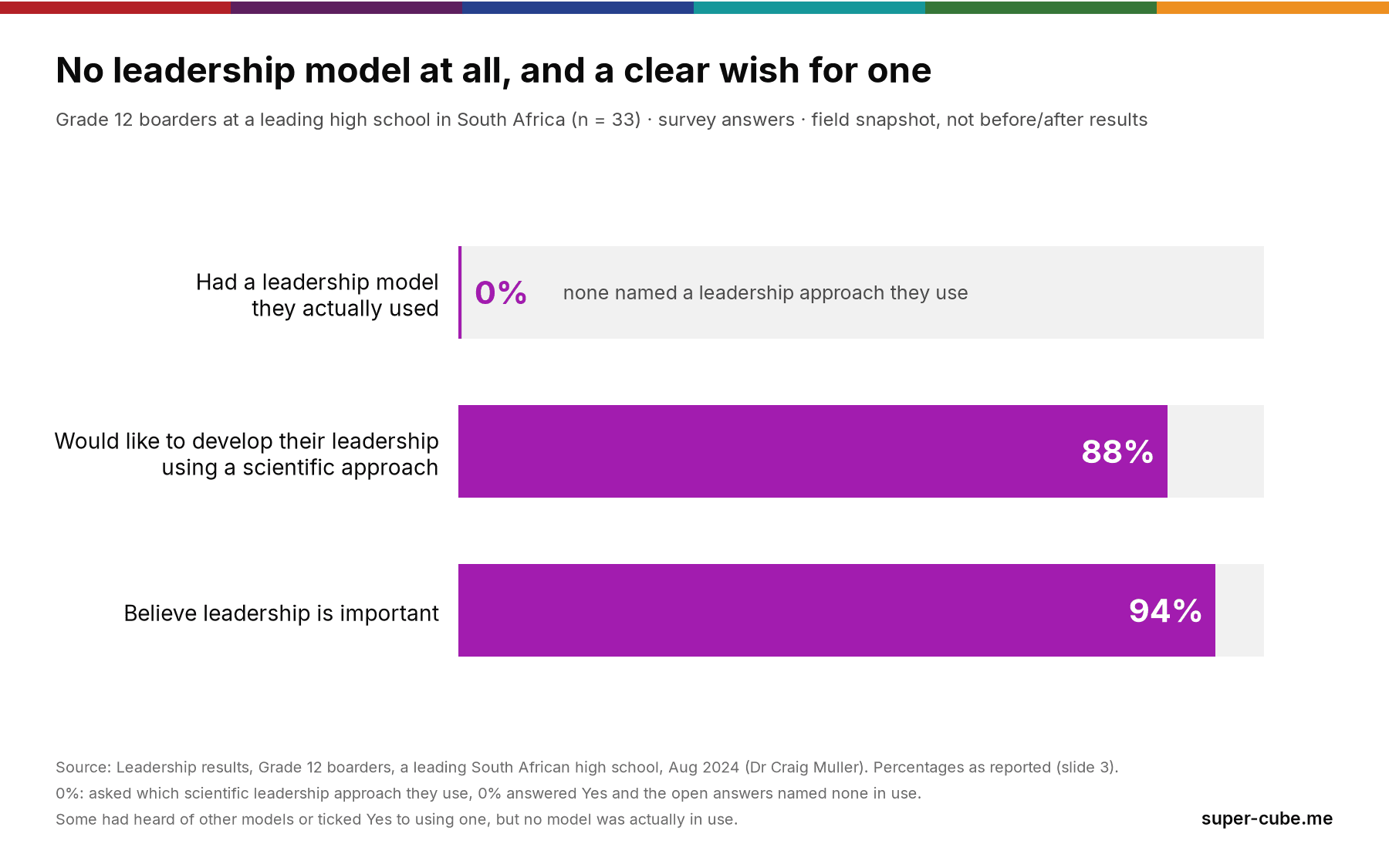
Source: Leadership results, Grade 12 boarders, a leading South African high school, August 2024 (Dr Craig Muller). Survey answers as reported (n = 33). 0%: asked which scientific leadership approach they use, none answered yes and the open answers named none in use.
Strong values, fewer tools
The questions on the six Super-Cube® faces told the same story: strong values, with fewer formal tools to act on them.
- Values are strong. 100% say the choices they make in life are important, and 100% say principles are important. 90.9% care about other people's well-being. 84.8% believe they have the skills to lead people, and 84.8% would like a formal leadership position one day.
- Formal methods are thinner. 63.6% have been taught a formal studying or learning technique, and 57.5% have been taught different thinking techniques. 69.7% don't have a formal (scientific) way to manage stress.
What the report recommends
Based on the boarders' answers, the report makes three recommendations:
- Offer leadership development as a subject or course for those who want to develop their skills.
- Use a scientific approach, with relevant, grade-appropriate and stimulating content to help accelerate leadership education.
- Give each learner a bespoke Super-Cube® leadership plan.
It proposes eight contact sessions across the school year: an introduction to leadership, the six Super-Cube® faces (Choices, Principles, Mental, Emotional, Physical and Spiritual) and a closing summary. Along the way, learners prepare and revise a plan for their lives, including the values they believe are important, and present it to their parents and/or teachers.
What it means
Young people can value leadership, and want to grow in it, and still have no model to steer by. Super-Cube® gives them one: a single, structured model of six faces they can use to see where they stand, choose what to work on and keep coming back to as they grow.
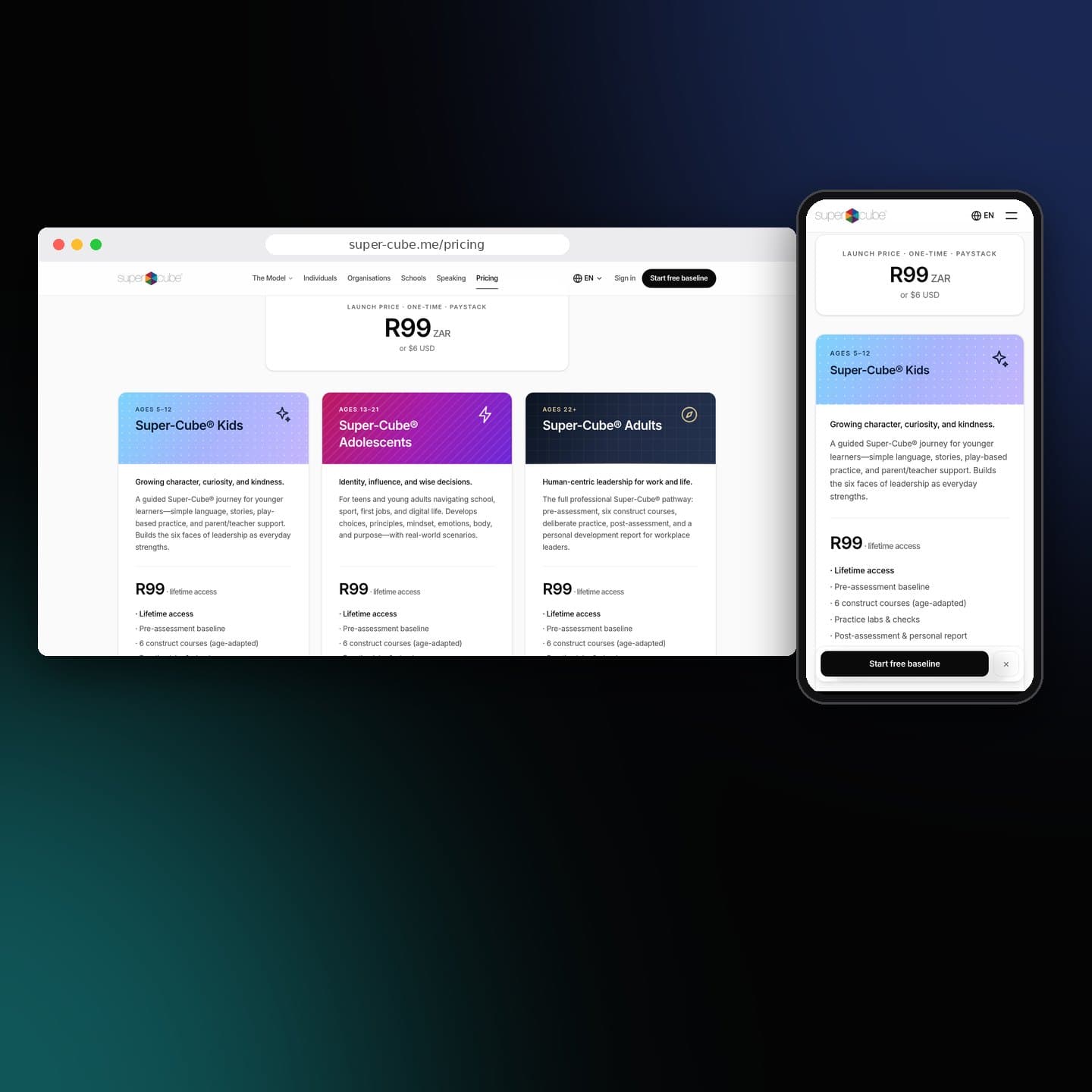
That's the thinking behind Super-Cube® Adolescents (ages 13–21): identity, influence and wise decisions, in age-appropriate language, with real-world scenarios from school, sport and digital life.
- A free baseline across all six faces
- Six age-adapted construct courses, with practice labs and checks
- A post-assessment and personal report
- R99 once, with lifetime access and no subscription
Schools can run the same pathway with a whole grade, using cohort codes for teachers. Learner journals stay private, and progress is shared only with consent.
Give young leaders a model to steer by
- Parents and learners: start the free baseline, then unlock Super-Cube® Adolescents for R99 once.
- Schools: bring Super-Cube® to a grade or the whole school.
About this field snapshot. These are self-reported survey answers from one group of 33 Grade 12 boarders at a leading high school in South Africa who took part in a brief Super-Cube® leadership intervention in August 2024. They are not assessment scores or before-and-after results. On the survey, 24.2% said they knew of another leadership model before Super-Cube® and 6.1% ticked yes to using a scientific leadership model, but when asked which approach they use, none named one. The school is not named, and no learner is named or pictured.